How do you know if your top 10 risks reflects your actual exposure?
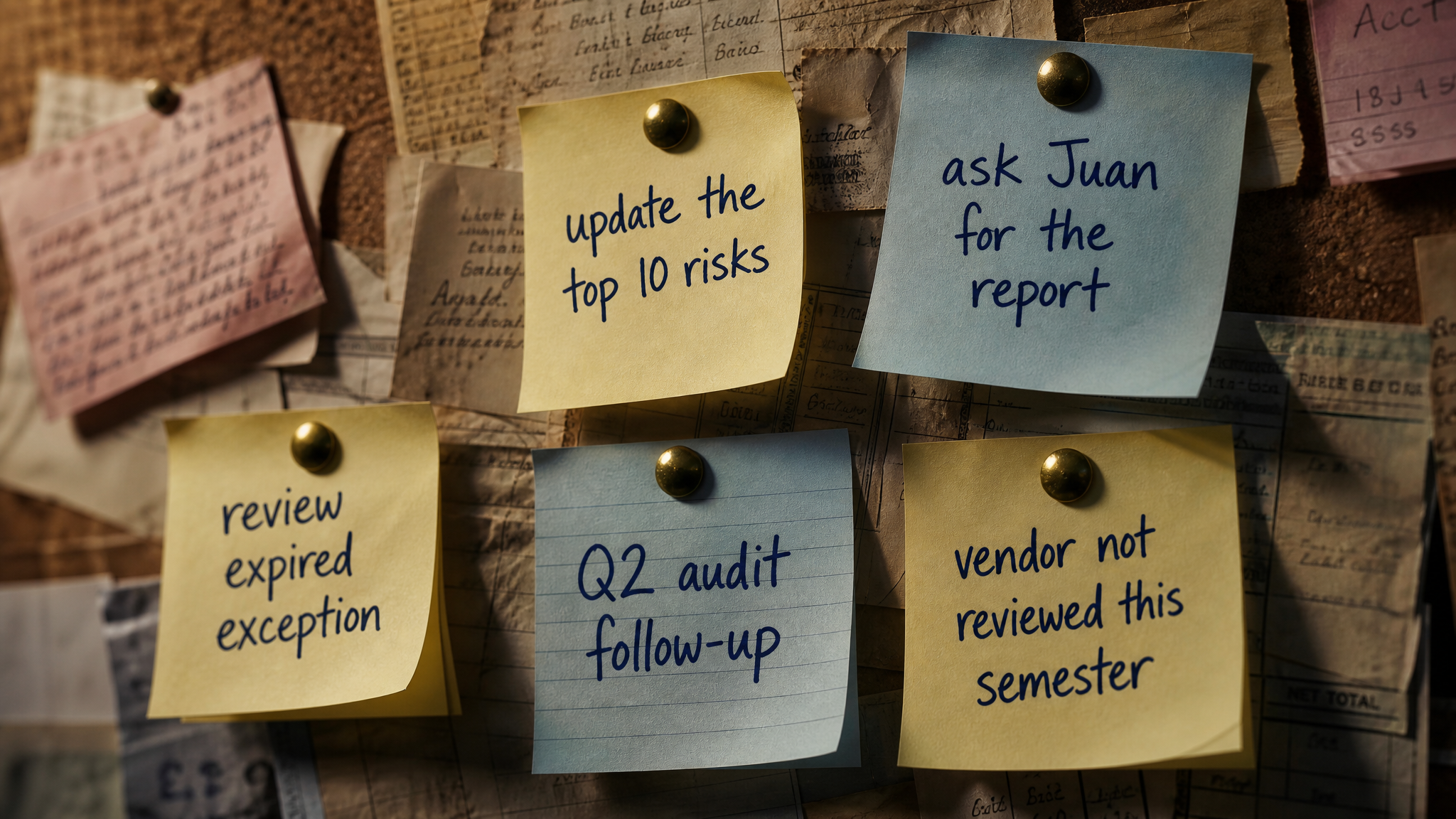
Every August it's the same. You come back from vacation, review the semester's agenda, and someone asks for "the list of the most important risks we currently have." Whoever is available puts the list together: ten lines, colors, levels, assigned owners. It looks serious. But if you ask why risk 3 ranked above risk 7, the answer almost always starts the same way: "because we recently had an issue with…" or "because the auditor mentioned it during the last visit."
An organization's top 10 risk list isn't a map — it's a snapshot of whatever happened most recently.
Lists that feel complete, but aren't
In most organizations, the risk register doesn't live in one place. Technology has its own, based on technical findings. Compliance has another, built from gaps against a framework. Operational risk builds its own from past incidents. Privacy keeps a fourth register. Each with its own methodology and its own criteria for what deserves a spot in the top 10.
When the moment comes to consolidate everything into a single sheet for the committee or leadership, the exercise stops being analysis and becomes curation of recent memory; the risks that make the cut are the ones someone remembers most vividly, not the ones that represent the greatest exposure. It's a well-known bias in any decision made under pressure: what happened two weeks ago weighs more heavily in someone's mind than what's remained unresolved for eight months, even when the latter is far more important.
Decisions built on an old snapshot
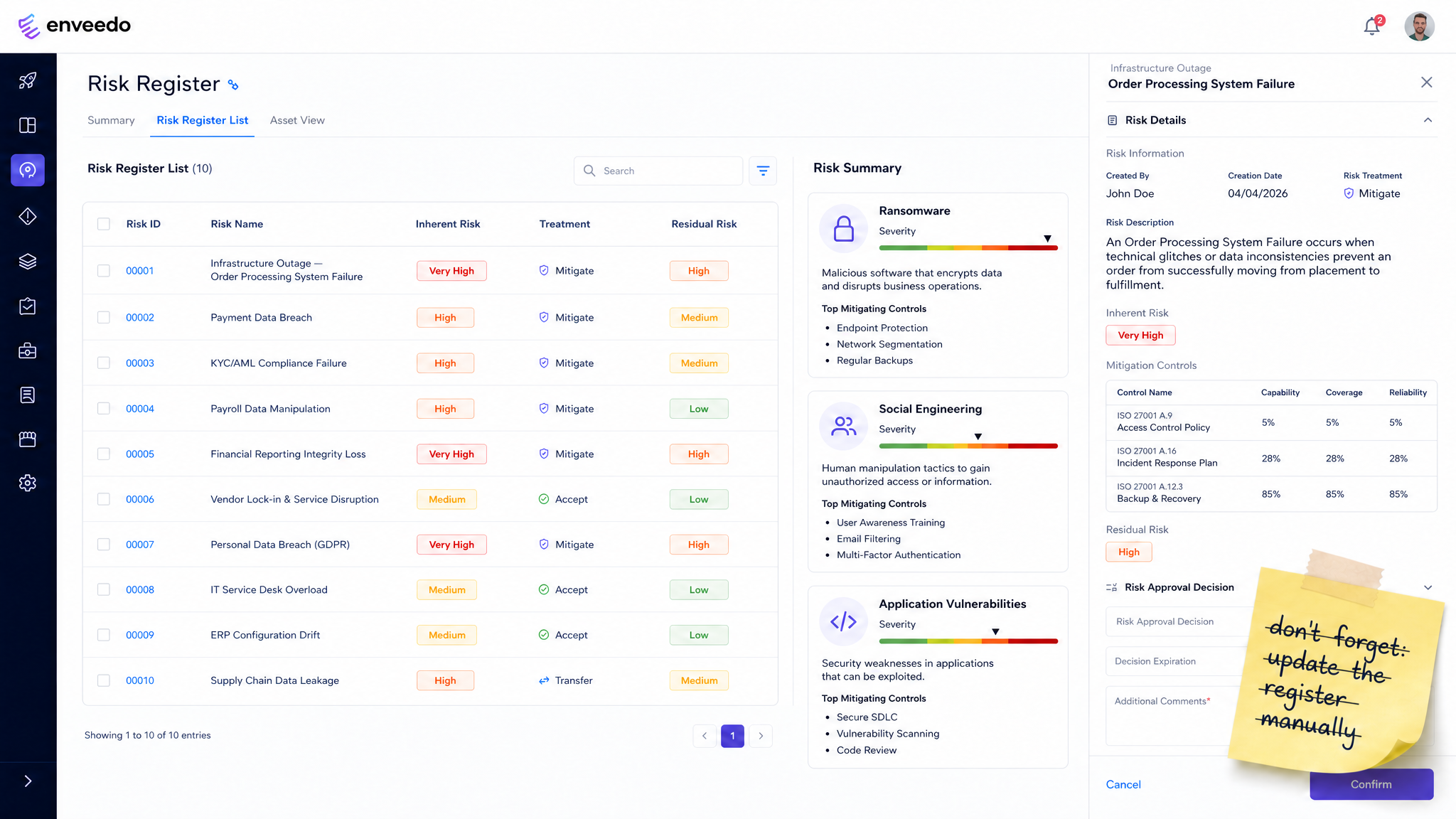
The problem isn't that the list is poorly written. It's structural: without a common logic connecting risk, control, evidence, and residual exposure within a single system, there's no way to know with certainty what the organization's actual posture really is. This is precisely the gap that a methodology like Cybersecurity Program Performance Management (CPPM) points to when it talks about "fragmented programs": the absence of a shared logic connecting pieces that today live separately.
This has concrete consequences. The first: budget and attention end up flowing toward whatever was most recently remembered, not toward where they're actually most needed. The second: traceability between inherent and residual risk gets lost, and without it, it's impossible to precisely answer the question any committee asks before approving more investment: "which controls are actually reducing this exposure, and which aren't?" Most people answer with reasoned intuition, not data, and intuition doesn't hold up in that conversation with leadership.
The third consequence is silent: the risks that never make the list because no one has them fresh in memory. A critical vendor that hasn't been reviewed in months. An exception "temporarily" accepted a year ago that's still there, off the radar, because no one built a mechanism to bring it back up when its deadline expired. These tend to be exactly the risks that end up materializing.

From remembering to seeing
Taking control of the risk map doesn't mean making a longer list or having a better memory. It means the opposite: taking that construction out of people's heads and placing it inside an operational logic where risk, control, evidence, and residual exposure live connected, update themselves, and can be consulted at any time.
That's the difference between managing risk as one-off documentation exercises and operating the program as a continuous system. With a shared methodology across technology, compliance, third parties, and privacy, the top 10 stops being a subjective selection and becomes the natural result of looking at the data: the risks that truly carry the greatest residual exposure rise to the top on their own, without anyone needing to remember them.
That's the underlying promise of Cybersecurity Program Performance Management (CPPM) — not adding another tool for keeping a tidier log, but a shift in model: moving from a fragmented program, with partial snapshots by area, to one under control, where real exposure is visible to whoever needs to make decisions about it.
Three questions to put your top 10 to the test
-
Can you explain the ranking with data, or only with memory? For each risk, ask yourself whether its place on the list reflects a calculated residual exposure figure, or "whatever happened most recently." If most of them sound like the latter, the list is built on memories.
-
What happened to the risk you accepted six months ago? Look for a formalized exception from the first half of the year and ask whether it's still valid or has fallen off the radar. If there's no quick answer, that risk is living off the radar — and it's probably not the only one.
-
Which critical vendor hasn't been reviewed this semester? If that list doesn't exist immediately, there's an entire portion of business exposure that isn't making it into any top 10 today, simply because no one has it top of mind.
If any of these questions left you without a clear answer, that's not a problem with your team — it's evidence that the program is still operating on the logic of memory, not of a system.
From the list that's remembered to the program that's controlled
No organization decides to manage its risks by intuition. It happens gradually, as the register ends up scattered across spreadsheets and the memory of whoever's been on the team the longest. Getting out of that doesn't require a better memory — it requires no longer depending on one, and building a system where real exposure is visible without needing to be reconstructed from scratch every time. That's the disruption Enveedo proposes against the legacy model of spreadsheets, shared folders, and traditional GRC.
Answer these 3 questions this week. If any leaves you with more doubts than certainties, it's time we explore together how to take control of your program.

No Comments Yet
Let us know what you think